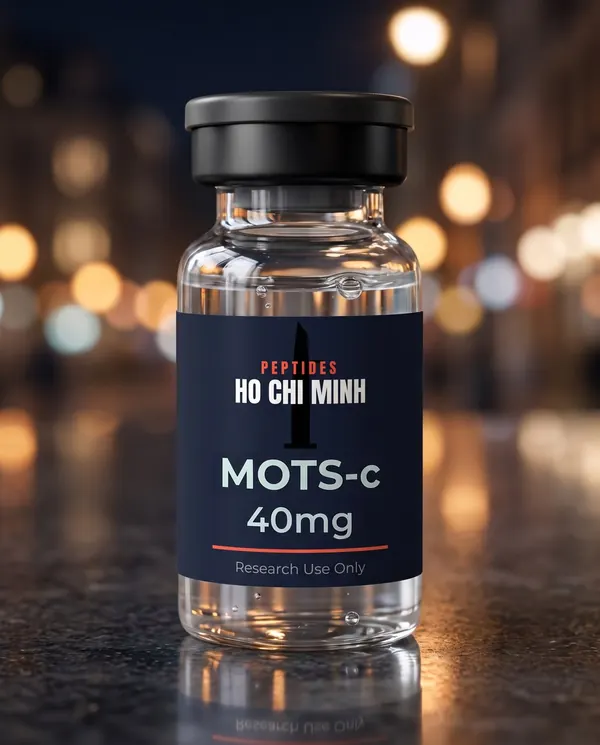
MOTS-c 40mg research vial
MOTS-c is a 16 amino acid peptide whose code sits in the DNA of mitochondria; a 40mg vial is 4,700,000 VND ($185 USD). MOTS-c's four papers are linked to PubMed below, and the price above dates from 11 October 2026.
What is MOTS-c?
Mitochondria are the small energy makers inside cells, and they carry their own DNA.
MOTS-c was first described in 2015, so its research is young.
MOTS-c since its 2015 discovery
- Animal study, 2015. The first MOTS-c paper put mice on a high-fat diet and measured fat gain and insulin response, with muscle as the main tissue studied.
- Cell study, 2018. The team tracked where MOTS-c went inside cells that were short of sugar, and measured gene activity.
- Animal study, 2021. Young, middle-aged and old mice were tested for running and physical ability with MOTS-c.
- Exercise study in people, 2021. 30 people had their own MOTS-c measured in blood and muscle around exercise, and the rise seen was small and unclear. Nobody was given MOTS-c.
Cell and mouse studies since 2015, and our search found no trial that gave it to people. It is early research.
How to read this
MOTS-c is young as a research subject, and the record shows it: one founding mouse paper, a cell study, a mouse exercise study and one human study that only measured the body's own levels. Our search found no published trial that gave MOTS-c to people. Early mouse work is a starting point, and it often looks different once larger studies run.
The MOTS-c paper trail
Two of the four papers ran in Cell Metabolism: the founding 2015 mouse paper and the 2018 cell study. The 2021 mouse exercise work appeared in Nature Communications, and the 2021 human study in the Journal of Applied Physiology. That human study gave nobody MOTS-c. It tracked the levels people already had in blood and muscle around exercise. In the 2018 cell work, the peptide moved into the nucleus, the cell's control center, when the cells were short of sugar. Four papers in six years is a short record.
Sources: PubMed record 25738459 (animal study, 2015); PubMed record 29983246 (cell study, 2018); PubMed record 33473109 (animal study, 2021); PubMed record 34351816 (Exercise study in people, 2021).
How much does MOTS-c cost per pack?
| Pack | Price | Per vial | Per mg |
|---|---|---|---|
| 1 vial | 4,700,000 VND ($185 USD) | 4,700,000 VND ($185 USD) | 117,500 VND ($4.63 USD) |
| 3 vials | 11,421,000 VND ($449.55 USD) | 3,807,000 VND ($149.85 USD) | 95,175 VND ($3.75 USD) |
| 5 vials | 16,920,000 VND ($666 USD) | 3,384,000 VND ($133.20 USD) | 84,600 VND ($3.33 USD) |
| 10 vials | 28,200,000 VND ($1,110 USD) | 2,820,000 VND ($111 USD) | 70,500 VND ($2.78 USD) |
Questions about MOTS-c
What has research on MOTS-c looked at?
Fat gain and insulin response in mice, where it goes in cells, and running ability in mice. Our search found no trial that gave it to people.
When was MOTS-c first described?
In 2015, in a mouse paper in Cell Metabolism. Its code sits in the DNA of mitochondria, which carry their own small set of genes apart from the main DNA in the cell's nucleus.
What is the difference between MOTS-c and NAD+?
MOTS-c is a peptide, 16 amino acids long, coded in the DNA of mitochondria. NAD+ is no peptide at all but a small helper molecule that cells need to turn food into energy. Both sit on the same shelf here, as separate research vials.
How many papers name MOTS-c?
265 in PubMed on 18 October 2026, all from 2015 on, since that is when it was first described. No trial in the record has given MOTS-c to people; the 2021 human study only measured natural levels.
By Peptides Ho Chi Minh, 11 October 2026